

Welcome to the National Space Trail
Welcome to the National Space Trail
Welcome to the National Space Trail

Welcome to the National Space Trail
EVERY STEP TELLS A STORY


The Trail Starts Here
Join us on first leg of the Trail in Massachusetts
with Dr. Robert Goddard “Father of the Space Age"
The Father of the Space Age,
Dr. Robert Goddard’s house
1 Tallawanda Drive, Worcester, MA
Known as “Maple Hill” this is the Multi-generational home of the Goddards. Dr. Goddard was born in 1882 in the 2nd-floor bedroom and did all his principal research and early testing while living there and teaching at Clark University.


South High School (now The Goddard School for Science
and Technology)
14 Richards Street, Worcester, MA
Goddard attended South High School, and his talents were recognized early, and he was encouraged by his physics and math teachers, Calvin Andrews and Miss Fields. He prospered at South and graduated as class valedictorian in 1904.
Mechanics Hall
321 Main St, Worcester, MA
South High held their graduation ceremonies at Mechanics Hall, At the conclusion of his speech he closed with a quote that he became famous for.
At his graduation ceremony in 1904, he gave his class oration as valedictorian. In his speech, entitled "On Taking Things for Granted", Goddard included a section that would become emblematic of his life:
"Just as in the sciences we have learned that we are too ignorant to safely pronounce anything impossible, so for the individual, since we cannot know just what are his limitations, we can hardly say with certainty that anything is necessarily within or beyond his grasp. Each must remember that no one can predict to what heights of wealth, fame, or usefulness he may rise until he has honestly endeavored, and he should derive courage from the fact that all sciences have been, at some time, in the same condition as he, and that it has often proved true that the dream of yesterday is the hope of today and the reality of tomorrow.

“It is difficult to say what is impossible,
for the dream of yesterday
is the hope of today
and the reality of tomorrow.”
Robert H. Goddard
As a physics instructor at WPI, Goddard was allowed to use university facilities for some of his early work with powder rockets. He set up a lab in the diminutive Magnetic Laboratory building (now known as Skull Tomb), which had been built without any iron to host experiments on electromagnetism. Here he conducted work on a rocket that would have been propelled by a series of explosions from cartridges loaded one at a time into a breech block not unlike what is in the firing mechanism of a machine gun. Parts for Goddard’s test devices were made in WPI’s shops, and he frequently sought help from WPI faculty members to find alternative solutions.
Worcester Polytechnic Institute (WPI) Skull Tomb
100 Institute Road Worcester, MA

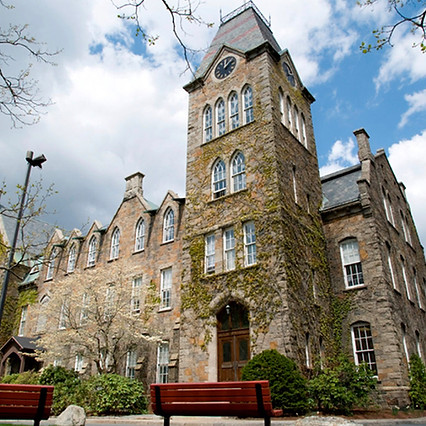
Worcester Polytechnic Institute (WPI) Goddard Hall Building
100 Institute Road Worcester, MA
In 1904, Robert Goddard enrolled at WPI and elected the relatively new General Science major.
While studying at WPI, Goddard filled notebooks with speculations and ideas about the potential for conquering space. He summarized them in an essay for his English class with the intriguing title “Possibility of Investigating Interplanetary Space.” He later submitted this piece to Scientific American.
On June 11, 1908, Robert Goddard received his Bachelor of Science with highest honors and won the “brightest student” award. After graduation, he briefly taught physics at the Institute alongside his mentor and head of the physics department, A. Wilmer Duff.
WPI honored Goddard by naming its chemistry and biochemistry building for him in 1965—the university’s centennial year.
Clark University
950 Main St, Worcester, MA
Robert H. Goddard is a two-time alumnus of Clark University, receiving his master’s degree in 1910 and his Ph.D. in 1911, and served as a professor in Clark’s Physics Department for 29 years. Goddard conducted his pioneering rocketry research in laboratories at Clark, with funding from the Guggenheim Foundation for the Promotion of Aeronautics allowing him to advance his innovations in the field, including proving that a rocket would perform in a vacuum such as outer space. Ironically, one of Dr. Goddard’s many students was Edwin Aldrin Sr., an early aviator and father of astronaut Buzz Aldrin!
It was here in the physics department at Clark University, that Robert H. Goddard invented and assembled the world’s first liquid-fueled rocket. On March 16, 1926, he successfully launched it from his aunt’s farm in nearby Auburn, Massachusetts. This historic achievement ushered in the modern Space Age and marked humanity’s first step toward leaving Earth to explore the universe.
.jpg)
The Robert H .Goddard Library opened in 1969. Buzz Aldrin attended the ceremony and cut the ribbon. Aldrin's father, who had been a friend and student of Robert Goddard, also attended the opening. The Goddard Library’s Archives and Special Collections Department house and protect the world’s most extensive collection of Dr. Goddard’s original photos, films, journals, notebooks, patents and blueprints.

Robert H. Goddard Library
950 Main St, Worcester, MA
Goddard launched the world's first liquid-fueled (gasoline and liquid oxygen) rocket on March 16, 1926, in Auburn, Massachusetts. Present at the launch were his crew chief Henry Sachs, Esther Goddard, and Percy Roope, who was Clark's assistant professor in the physics department. Goddard's diary entry of the event was notable for its understatement:
The rocket, which was later dubbed "Nell", rose just 41 feet (12.5 meters) during a 2.5-second flight that ended 184 feet (56 meters) away in a cabbage field,[62] but it was an important demonstration that liquid fuels and oxidizers were possible propellants for larger rockets. The launch site is now a National Historic Landmark, the Goddard Rocket Launching Site.

Goddard Launch Site
20 Upland St, Auburn, MA
The Eco Tarium
222 Harrington Way, Worcester, MA
The EcoTarium is a dynamic museum in Worcester, Massachusetts inspiring the next generation of space explorers to reach for the stars. Discover the cosmos in the immersive full-dome Alden Planetarium, experience a rocket launch in the exhibit “Lift Off! Space Explorers” with NASA mission control, learn about how telescopes work, and gaze at the stars in the Observatory!
The EcoTarium’s legacy is rooted in Worcester’s pioneering contributions to rocketry and space science. Mrs. Esther Goddard, research partner, photographer, and widow of rocket pioneer Dr. Robert H. Goddard, was celebrated as the Museum opened its new location. Navy-veteran and NASA Astronaut Captain Jim Lovell arrived at the dedication ceremony in a Navy SH-3 helicopter to the cheers of thousands of local children and community leaders. Together Mrs. Goddard and Captain Lovell passed the torch of innovation and curiosity to future generations.
Today, the EcoTarium continues to celebrate the spirit of exploration, connecting visitors of all ages to the science, creativity, and ambition that fuels humanity’s quest for the stars.
.png)
Why Worcester ?
The City of Worcester, and those who manage its operations at Worcester City Hall, have long fostered a spirit of innovation. The combination of the city’s educational infrastructure, industrial capability, and sustained institutional support during Robert Goddard’s lifetime helped create the ecosystem that he needed to become the father of modern rocketry.
Today, that innovative spirit can still be seen, with the Commonwealth designating the city a “TechHub” acknowledging its place as a center for Life Sciences. It has also maintained its industrial past, acting as a home to advanced manufacturing, robotics, precision machining, and prototyping.
The City of Worcester

Worcester, Massachusetts has long stood as a city of innovation—an energetic incubator where visionary ideas take shape and modern technology is born. From the pioneering rocketry experiments of Robert H. Goddard to today’s thriving clusters of biotech, advanced manufacturing, medical research, and robotics, Worcester has repeatedly proven its ability to nurture bold thinkers and transformative breakthroughs.

Massport / Worcester Regional Airport
Next Stops on the Space Trail
We’re making great progress on the first 8–10 sites of The National Space Trail, starting in Worcester and Auburn, MA.
NEXT, we plan to expand statewide, then nationwide.
A steering committee will help identify new sites and raise funds to bring them to life with interactive web links.
TO CONTINUE GROWING we’re seeking donations and sponsorships
to support installations at deserving sites that lack funding.
Interested in sponsoring, volunteering, or suggesting a site?
REACH OUT at: info@thewondermission.org
— we’d love your involvement at any level.

